
Want to experience some of Europe’s most spectacular mountain rides? The Dolomites in Italy and the Julian Alps in Slovenia are without doubt two of the best regions in the world for bike touring. With dramatic passes, quiet valleys, and cyclist-friendly towns, they’re perfect for a multi-day cycling adventure.
In this guide, I’ll share recommended routes, tips on when to go, and what to expect on a Dolomites cycling tour, extending to neighbouring Slovenia.
Cross Dolomites & Julian Alps Cycling Route
The following bike route itinerary is based on road bike credit card touring that’s more apt for a Dolomite cycling tour than full-on bike-packing.
Total distance: 632km (393 miles for you Brits)
Total climbing: 10,100m (33,140ft)
Suggested duration: 8-12 days
Purely out of convenience and affordable flights, I started in Verona and made my way West to East. There is no reason you can’t do the reverse, say landing into Venice or Trieste then taking the train up to Gorizia or say Tarvisio, depending on how much you want to cover. The route mostly covers Italy and a small venture into neighbouring Slovenia, a hidden gem cycling destination not to be missed on 2 wheels.
Daily distances and total elevations vary wildly and you’ll be wise to judge based on your fitness, but the longer legs can easily be split into smaller sections while still finding accommodation.
Day 1: Verona to Trento via Lake Garda
119km
870m
If you want to take in lakeside scenery before venturing into the mountains, a mostly-flat leg day exploring both shores of Lake Garda makes for a perfect warm-up touring day.
The Verona to Trento cycling route starts off by joining the dedicated bike path heading East along the Adige canal towards Bussolengo, then veer off to the picturesque coastal town of Lazise. From there, it’s mostly a flat ride past lakeside villages of the Eastern Garda shore mixed with colonies of German tourists downing steins, along with plenty of opportunities for a refreshing dip along the way.
At Malcesine, I recommend taking a short and very scenic ferry across to Limone on the other side. As the name suggests, the town is known for its lemon groves and is squeezed by rocky cliffs to the South. From Limone you’ll enjoy a stunning new dedicated bike section heading North above the steep cliffy Western shore of Garda. A real highlight of the day.


Getting to Riva del Garda involves a short busier tunnel section before enjoying your last views of the majestic Garda. Depending on your ambitions, you can base here or push onto Rovereto or even Trento as I erroneously did (getting to my Airbnb by pitch-dark 9pm). There is one chunky climb to tackle out of Riva before descending into the alluring vineyard-covered landscapes of the Adige Valley.

Alternative route option
If you can’t wait to get your teeth straight into the Dolomites, take a 1-hour train from Verona straight to Trento. No need to book bike reservations – no one ever checks – just take the regional train. Or you could get the more direct flat bike path route along the Adige, but that’s kind of monotonous especially in the first half.
Trento, by the way, is a lovely city and it’s worth a couple days exploring it and the local surroundings. A day ride out to Sugana Valley (Valsugana) is a particular highlight. You can find more info about this in my hidden gem Italy guide here:
Read more: Hidden Gems of Northern Italy
Day 2: Trento to Canazei
96km
1,563m
The Trento to Canazei leg on day 2 offers you the first taste of the Dolomites in what is a punchy ride in terms of climbing. The first section heading north out of Trento continues along the traffic-free and thoroughly enjoyable Val d’Adige dedicated bike route past a sea of vineyards and orchards.
The first real climb of the day (600m) takes you up from Lavis into the Cembra Valley, dotted with enchanting German-speaking villages. At this point the cultural border becomes fuzzy and you just won’t know which language a shop owner will answer in (that said they more than likely speak some English).
The SS612 road doesn’t have a bike lane but isn’t particularly treacherous. Before long you’ll join the separate asphalted bike path with an almost-unnoticeable incline up the valley into Canazei. A popular Alpine resort, the town makes for a great option to base for the night with a plethora of accommodation options.


Being a masochist, I opted for a hotel at the top of Passo Pordoi, another 700m climbing of 27 hairpin turns up from Canazei. Lower forest-covered switchbacks open up to dramatic Alpine views towards the top and this is when you first get to marvel at the Dolomite views for the first time. The well-earned beer at the top couldn’t have been more sweet! And by the way that place was excellent – it’s called Hotel Col di Lana.
Day 3: Sella Ronda
63km
2,070m
If you’re not in a rush and your legs are still up for it, I recommend leaving your luggage for a day and making the most of the beautiful surroundings. The famous Sella Ronda is one of the most stunning highlights of any Dolomites cycling tour: a perfect loop out of Canazei (or indeed Passo Pordoi) to take in 4 of the most famous passes the Dolomites has on offer. It’s a relatively short route yet feels anything but: at all points you’ll either be climbing (relentlessly but with mild gradients) or loving the rewarding long descents.

Going clockwise from Canazei, your first challenge is the Sella Pass, offering incredible views of the razor-sharp peaks in every direction. A brief respite follows with a descent down to Plan de Gralba before a somewhat shorter climb up to Passo Gardena.
From Passo Gardena you’ll experience one of the most incredible and long descents in your life, down to another famous ski resort of Corvara that makes for a great lunch stop. From there you have a 300m up and down towards Arabba before the big ascent of the day up to Passo Pordoi. As with most climbs here, it’s a relentless switchback ascent but never ventures into painful gradients. Slog on and let the views keep you going!
Reaching Passo Pordoi, you’ll notice a memorial to the legendary climber Fausto Coppi and a small but interesting WW1 museum reminding you of the horrors that once took place up in the Alpine frontlines of the Dolomites.

Day 4: Canazei to Val di Fassa
86km
1,736m (starting from Canazei)
This is where staying on top of Passo Pordoi really benefits. Well, sort of. You get to enjoy the long descent down to Arabba as you still digest breakfast, but in my case the day started with a tooth-chattering +4C and relentless rain (and that’s in the middle of August!).
From Arabba, the route takes you along a rare flat section above a valley before taking onto today’s big climb – the Passo Falzarego. It’s another strikingly beautiful pass and a 700m ascent from Cernadoi that isn’t steep and allows you to enjoy the scenery with every pedal stroke. The views really open up as you reach the peak, and a welcome restaurant / cafe awaits at the top for a well-earned top up. There is a cable car at the top (Funivia Lagazuoi) that will take you up where the bike can’t.


Alternatively you can also take the Passo Fedaia, but according to a local guy at a bike shop it’s the harder option and both passes are beautiful so with the raw leg situation I confidently opted for Falzarego.
From Falzarego, a tantalisingly long descent ensues down to the famous and touristy town of Cortina d’Ampezzo, backdropped by postcard-perfect Dolomite views. From Cortina you can join the Dolomite Bike Road, a disused railway turned into a mostly-tarmacked car-free bike path. It’s refreshingly flat from here with a gentle descent, the only thing slowing you down is the continuous desire to stop and soak in the views.

Dotted along the path are disused train stations, railway tunnels and picturesque villages. The many villages and towns of the Boite Valley are a perfect base for the night (at great value). I chose a quaint Airbnb near Pieve di Cadore, a well-placed starting point for the day ahead.


Day 5: Boite Valley to Tolmezzo
71km
1,380m
A less strenuous day mostly free of big climbs.
The Boite Valley to Tolmezzo route begins with a visit to the emerald-green Lago di Cadore. There is a bridge (Ponte di Domegge) from which you can enjoy the best views and cross onto the mostly car-free road than eventually climbs up to Lorenzago di Cadore with a beautiful town square. From Lorenzago your only climb of the day continues another 300m or so metres up the forest-heavy SS52 road until you reach Passo della Mauria.

After the relatively tame pass, it’s a mostly a long 1,000m descent flying down to Tolmezzo. At some point you can join a dedicated cycle way making for some car-free riding in the valley. Tolmezzo is a fairly indistinct industrial town but a decent option as a place to stay. I stayed in nearby Carnia (is this where vegans go to hell?) which is on the train line down to Udine and Gorizia in case you want to wrap up the Dolomites cycling tour here.

Day 6: Tolmezzo to Kranjska Gora
82km
1,207m
At this point I decided to extend my Dolomites bike tour to the neighbouring Slovenia and its Julian Alps.
The route from Tolmezzo / Carnia will take you on a gradually increasing incline up to the last Italian outpost of Tarvisio. From there, take the dedicated bike route through the border town of Rateče as you cross in Slovenia. I could barely tell when I crossed the border. Before long, you’ll descend down to Slovenia’s best-known alpine resort of Kranjska Gora. It’s the gateway to Triglav National Park and can get busy in the summer so if you want to stay here, book your accommodation in advance.

Just south from Kranjska Gora, be sure to visit the stunning Jezero Jasno before taking on the long ascent. Or you can leave it for the next day on the way to Vrsič Pass
Day 7: Kranjska Gora to Kobarid via Vršič Pass
66km
1,134m
Today starts off with one monstrous climb – the Vršič Pass, so fuel up accordingly. Thankfully, Slovenian breakfasts are more hearty than the flimsy pastry & coffee in Italy. The road 206 is steeped in history dating back to WW1. Back then, the Vrsič Pass was commissioned by Austro-Hungarians to carry supplies across to the front line and the road is actually known as the “Russian Road” having been built by Russian prisoners of war.
Around halfway up you’ll come across the wooden Ruska Kapelica (Russian Church). The small church was built in memory of the many Russian POWs who tragically perished in an avalanche during the road’s construction. It’s a nice excuse to take a breather from the relentless climbing.

The forest-covered ascent mostly lacks the open views of many Dolomite passes up until you reach the peak. Near the top is a great lunch stop called Erjavčeva Koča where you can savour some of the local Alpine delicacies. You can also stop at the wooden refuge for the night if you so choose.
Past the peak, it’s a speedy descent down as the road joins the Soča River gorge. A must-stop on the way is the Velika Korita Soče (Great Soča Gorge) where you can really take in the surreal azure colours of the Soča.

Eventually the valley evens out as you cycle past Bovec (another worthwhile stop) into Kobarid. This valley town is particularly pleasant and a place of historic significance. It is here at the Battle of Caporetto where the Italians retreated after a heavy defeat, the town largely destroyed in the process. An Mussolini-era Italian military shrine houses 7,000 fallen soldiers and is worth a visit if at least for the best hilltop views of Kobarid.
The Napoleon Bridge over the Soča River gorge is another must-see in Kobarid, where Napoleon’s troops once marched on their way to conquer the rest of Europe.
For accommodation I really recommend Hostel Kobarid, a modern hostel with beautiful gardens and one of the best hostels I’ve ever stayed in.


Day 8: Kobarid to Gorizia
58km
515m
It’s time to give your legs a welcome break and leisurely enjoy more Slovenian scenery, this time with only a few modest ups-and-downs rather than big passes as you gently descend to your final destination. Follow the quiet country lane north of Soča river to Tolmin before crossing to join the 103 road that will cut back towards the Soča Valley.
Up until Doblar you’ll need to continue on the rather busy 103, after which turn off onto the mostly traffic-free road through sleepy Slovenian villages that eventually becomes a bike path. There are plenty of opportunities to cool off in the emerald waters of the now-wide Soča. After an easy final stretch you cross the tall bridge into Solkan and finally the twin cities of Nova Gorica & Gorizia.

Gorizia / Nova Gorica is a unique city in that the Italian-Slovenian border cuts right across it. Back in the Yugoslav days this would have meant a fully walled border but since 2004 you can nip in and out of Italy as much as you like along the country-crossing streets. A plaque in the centre of Transalpina Square (in front of Nova Gorica train station) marks the spot where a border wall once stood.
Gorizia in the Italian half is well-connected by trains to the rest of Italy hence an ideal finish destination to take a train back to your starting point.

Bonus: Side Cycling Trips in Slovenia
Slovenia is a stunning hidden gem country for cycling and deserves its own tour (which I’ll cover in detail some day). But if you have more time on your Dolomites tour, there are a couple excellent options to extend your cycling adventure that I couldn’t help but share.
Cycling Bohinj & Bled Lakes

Slovenia’s most famous sight is probably Lake Bled and its island church. But not far South from Bled is a lesser-known, more stunning and definitely more tranquil lake – Bohinj. Best of all, the two are connected by the tough but almost traffic-free road.
The emerald colours of Lake Bohinj are so surreal you’d think they’ve been photoshopped, and the surrounding verdant valley is brimming with nature. There are even a few lake beaches to take a compulsory dip in the clear waters. Slovenia’s national symbol (that even made it onto the national flag), the Triglav Mountain looms high above in the backdrop.
Lake Bled is more “commercialised” as a tourist spot but beautiful regardless, and unlike with Bohinj there is an asphalt road circling the lake.
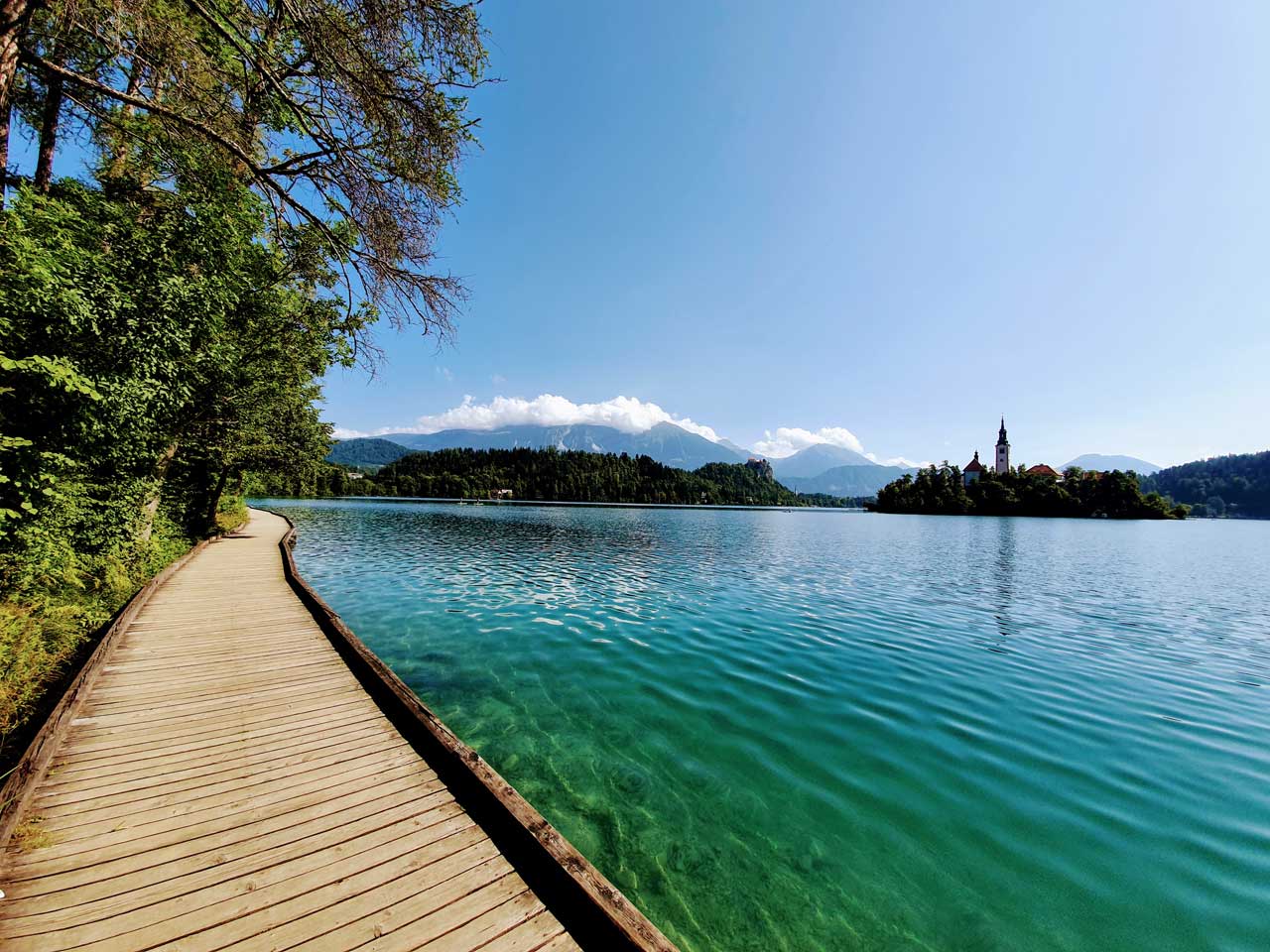
You can get to Bled easily from Kransjka Gora, or to Bohinj from the relatively busy 403 road. Instead I chose a train out of Nova Gorica up to Bohinjska Bistrica that’s a short hop from Lake Bohinj. After enjoying the first lake, I took the often steep 905 up to Pokljuka and its traditional wooden houses before a long wooded descent down to Lake Bled. The train from Bled will take you down the same line back to Nova Gorica.
Cycling Vipava Valley in Slovenia

Another fantastic tour extension heads East from Gorizia to Slovenia’s wine region. The broad, open valleys of Vipava Valley contrast greatly to the Julian Alps, instead reminiscent of Northern Tuscany. There are ample gravel routes to choose from to tour the quaint villages, hilltop castles and local vineyards, but plenty of quiet asphalt roads too. The climbs are plentiful and often punchy but few with elevation gains of over 200m.
The towns of Ajdovščina and Vipava make for good bases here with plenty of affordable accommodation. The medieval town of Štanjel with its cobbled streets was particularly picturesque and worth adding to your route.
The gravel route I made was planned last-minute on a phone and while mostly successful, involved venturing into a live shooting range. So I won’t be sharing it.
Tips for bike touring the Dolomites
What’s the best time to bike tour the Dolomites?
May to early October. Italian summers get hot in July and August but even if it’s +40c down in Verona, anywhere up in the Dolomites will be in the more bike-friendly mid-20s. Weather is changeable up in the mountains and you’re likely to get a few storms on your tour.
My first tour in early August included a nasty washout day with morning temperatures up in the passes as low as +4c in the morning, so bring layers especially for the downhills.
How do I get to the Dolomites?
If you’re starting West, Verona is the best airport with often cheap low-cost flights to European cities. Venice and Milan have bigger airports that will add an hour or two of travel but are also doable. You can even fly into Innsbruck Airport in Austria, as I once did, for an easy transfer onto a direct train to Trento.
How difficult are the Dolomites cycling routes?
Cycling up series of Alpine passes might sound daunting, but while the climbs are long they rarely venture into painful inclines and the views spur you on. I’ve found touring on the roads of Wales and the Lake District more challenging as they rarely mess about with building hairpins.
Needless to say you’ll be ascending big numbers every day so a strong level of climbing stamina is important. That said, if you can regularly go up 300m climbs without throwing up your lungs you should be able to climb 800-1,000m so long as you take it steady.
Of course, it may help to cut the suggested route into smaller sections if you’re not sure about your fitness. There’s nothing worse than having to push through into the darkness to get to your overnight stop.
Should I book accommodation ahead in Dolomites?
Yes, I think you should, especially if you’re coming in the peak months like July-August. In larger towns you’ll surely find something last minute, but some of the more popular small hiking base towns and villages can fill up despite having quite a few ski resort hotels and nearby town might be some way away.
If you do book a few weeks ahead, thanks to all the tourism there are plenty of reasonable hotel / Airbnb options as well as a sprinkling of Warmshowers hosts along the way.
Can you rent bikes in the Dolomites?
Yes, you can definitely rent bikes in the Dolomites – it really depends where you choose to start / fly into.
I rented both times when visiting the region – once in Trento from Prestabici and another in Verona from ItineraBike – can vouch for both. You can also find rental shops in Bolzano and smaller tourist resorts of Cortina d’Ampezzo, Canazei or Dobbiaco. But it’s best to book ahead and check the range – some focus on e-bikes and casual cycles more than road bikes.
Hope this Dolomites and Slovenian Alps cycling tour guide helped you plan an epic bike adventure of your own, and if you have any questions feel free to leave a comment below.
You may also be interested in these bike touring guides:
- 14 Best Hidden Gem Cycling Destinations Around the World
- Around Sicily by Bike: A Cyclist’s Guide to an Epic Island Tour
- Bike Touring South Korea: A Beginner’s Guide
- Bike Touring Across Wales: A 4-Day Cross-Country Cycling Route
- Western Japan Bike Tour: Cycling Kyushu, Shikoku & Shimanami Kaido
Found this bike tour guide useful? You can support the site with a coffee ☕ — it helps cover hosting costs.


6 Comments
Amy Challoner
Hello!!!! My name is Amy and I am an Irish gal living in Hong Kong. I am so glad I found this blog. I want to do this exact route! I will be doing the Alta Via 1 with my friends this summer and then I want to do this cycle trip afterwards.
I have a few questions if you don’t mind…where can I rent a bike with panniers? I could leave my luggage in storage in Venice maybe and then just take the essentials in paneers. Do you also know if I rent a bike in Italy can I drop it off in Slovenia? Not sure if that’s a silly question!
I have been looking up many trips but they are all so costly and very strict on accommodation etc.
It would be great to hear back from you.
Regards,
Amy 🙂
Nikita
Hi Amy! I didn’t use panniers but I’m pretty sure the bike shop I rented from in Verona can sort you out – https://www.itinerabike.com/bike-rental/
I don’t think one-way dropoff across countries is an option, but it’s fairly easy to get back to Verona or Venice with local trains. Get a Slovenian train to Nova Gorica, cycle the border to Gorizia (Italian half of the same city) then take the Trenitalia to where you started.
Hope this helps. You have a fantastic journey to look forward to!
Nigel White
Thanks for this info. I’m planning a lightweight credit card tour of the Dolomites this summer. I will study your trip to make my plans.
I plan to start from my friend’s house in Moniga del Garda, but it will need to be a circular tour The logistics of transport with a bike back to a base are just too difficult.
Nikita
Hi Nigel,
I found the logistics not too bad. For example if you finished in Gorizia next to Slovenia, you can hop on with your bike onto a regional Trenitalia train and be in Verona in just over 3 hours, with a change in Venice if I recall.
Either way – hope you have a wholesome tour this summer!
Kazimieras
Hello. Nice trip! Leaving for italy tommorow, however, cant download day 4,7,8 . Would it be possible to reupload?
Nikita
Hey Kazimieras – thanks for letting me know. That should be all fixed now.
Have a great trip!