
There is no country quite like Bosnia. A land at the crossroads of civilisations, shaped by dramatic and at times violent history, and blessed with stunning nature – from emerald green rivers and majestic waterfalls to the Dinaric Alps. The fascinating mix Central European and Ottoman influences is resonated in every aspect of Bosnia’s culture, its architecture and its cuisine.
Muslims, Catholics and Orthodox Christians live in fragile harmony, although in the Balkan spirit of things they don’t always seem to get on. But rest assured – the locals are notoriously friendly and hospitable towards tourists, and let’s not forget it remains one of the most affordable destinations in Europe.
In every possible way, Bosnia is a true hidden gem that has it all. Whether you’re into history, nature, active holidays or engorging on local delicacies. There’s even a little bit of sea! Before Bosnia eventually follows in Croatia’s journey into becoming a popular tourist destination, there’s no better time to discover this country than now.
And for a small country, there’s so much to do and see that you’ll struggle to decide what to miss out on. So I hope that this Bosnia trip itinerary, best suited for a week or longer, helps you plan an unforgettable trip to the country that will be sure to leave you surprised.
The Perfect Bosnia Itinerary

As you can see from the map, my recommended Bosnia trip itinerary covers the country’s most impressive sights largely concentrated in the country’s southern and central regions. It follows perfectly starting from Mostar (or say, driving across from Croatia) and making your way to Sarajevo before travelling further up towards Jajce.
I think a great Bosnia road trip itinerary would combine into a loop that includes Croatia (and mixes in some seaside), so if you continue onwards to Una National Park you can continue onwards to Plitvica Lakes in Croatia and back to wherever you started.
Can this Bosnia itinerary be done by public transport?
This itinerary is designed to be done by car – but you can achieve most of it with public transport. You can take the train connecting Mostar and Sarajevo via Konjic, take buses to reach the towns around Mostar, and get a bus up to Jajce from either Sarajevo or Mostar.
Of course, this is less flexible and so a car is something I very much recommend for the best experience. We used DiscoverCars for our trip, which lets you compare both international rental companies and local Bosnian providers. Compare Bosnia car rental prices here →
Mostar
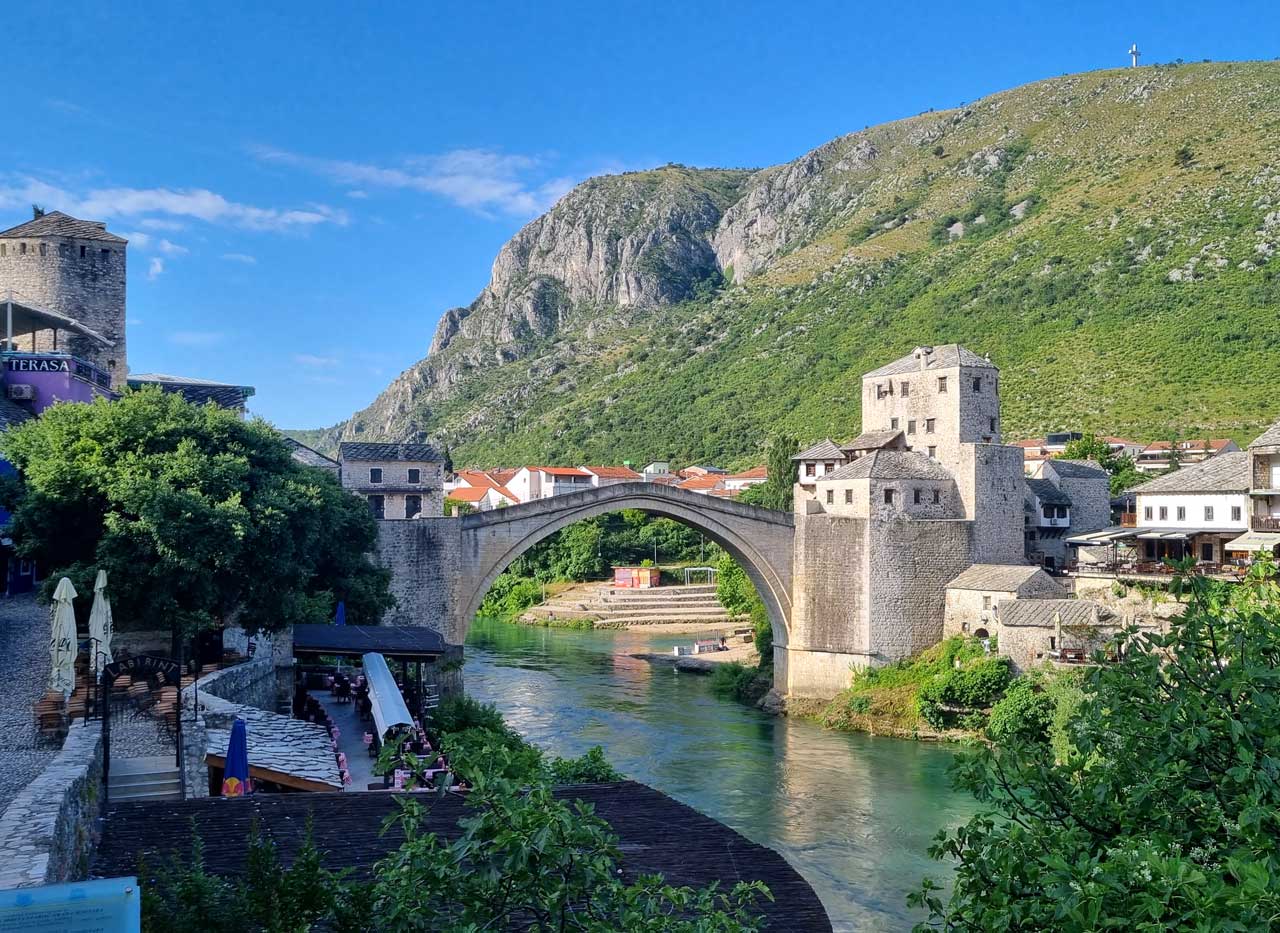
Let’s start with the obvious one. The city of Mostar, best known for its iconic bridge, is easily the country’s most distinctive and internationally known landmark. Its stunning bridge (Stari Most) is significant on multiple levels. It connects the two culturally distinct sides of the city – the mostly Croat (Catholic) west and the Bosniak (Muslim) majority East.
Particularly symbolic of the fighting that took place between the two sides during the Civil War, the bridge was one of the many victims of Mostar’s intense shelling. Rebuilt since, it’s now a symbol of the reconciliation. Although The two sides are still somewhat separate – with their own football teams, schools and cultural centers.
Spend a little time around the bridge and you might witness a centuries-old tradition – extremely ballsy divers plummeting off the 20+ meter tall bridge into Neretva River. We were told and not at all surprised that there is the occasional death among the jumpers – so don’t take your chances.
And there’s more to Mostar than Stari Most. Just explore the town by foot and you’ll discover little gems like the much smaller “Crooked Bridge” on the east side, Within the cobbled historic center you’ll find the Old Bazaar (Kujundziluk) dating back from Ottoman times. Nowadays it’s mainly a lineup of souvenir and craft shops.
If you’re into abandoned buildings (which there is no shortage of in Mostar), pay a visit to the Sniper Tower. A haunting symbol of the violence that once took place in the city, it’s the tower from which snipers picked out their targets. Nowadays it’s a graffiti-covered husk you can explore (with care) and take in the impressive views from.
Mostar’s cobbled historic centre is relatively compact, and let’s face it – of all the places in Bosnia this is the one that tends to get crowded during the tourist season. Especially when the day tour buses from the Croatian coast resorts roll in for the afternoon. But it’s one of those cities that’s easily worth it regardless.
Tip: Enjoy Mostar at it’s most tranquil with an early morning walk.
With a plethora of accommodation and eating options, Mostar serves as an excellent base from which to explore Bosnia’s surrounding southern region of Herzegovina – where so many of the country’s most interesting highlights are concentrated. Some of the best options for your day trips:
- Kravica Waterfalls
- Stolac (see above)
- Blagaj
- Pocitelj
Getting to Mostar
Mostar is reachable from Sarajevo by car along the picturesque E73 highway in around 2 hours. There are also direct (and cheap) trains from the capital that take 2.5 hours. Of course there are bus connections too.
From the Croatian coast, Mostar is roughly 2.5 hours from both Dubrovnik and Split – if you exclude the possible border crossing wait times.
Keep in mind that parking is paid pretty much anywhere in central Mostar – keep an eye out for street signs, you can usually pay via apps.
Stolac

The incredibly green and quaint town of Stolac is a place where culture, history and natural beauty come together. A huge contrast to the touristy Mostar, It’s a spot I really recommend at least for a stopover as part of your Bosnia trip.
The town stretches along the Bregava river, its old Ottoman houses interspersed with the odd empty, bullet-ridden husks. Nestled high above Stolac is the Vidoska Fortress, offering panoramic views across the city. But our main highlight was a leisurely walk up along the river. Before long you reach a beautiful cascade of waterfalls – and there’s even an old mill-turned-restaurant right next to it that I recommend checking out. The Provalije Waterfall is most impressive in spring and autumn when the water levels are high.
Stolac is the oldest town in Bosnia & Herzegovina, having been inhabited for 16 millennia and once one of the most important settlements in the region. If you visit the nearby Badanj Cave, the Paleolithic era horse drawings and symbols really demonstrate that. It’s a fairly adventurous path but absolutely worth it for this little hidden gem.
Alternatively, within easy range from Mostar there is another interesting town along the river called Pocitelj. But to be honest we didn’t manage to fit and despite an impressive hilltop fortress, it seemed less to miss out on between the two.
Getting to Stolac
You can visit Stolac on a day trip from Mostar (45 mins drive or direct bus), or as a stop on the way from Croatia or Neum. Or better still, stay for a night or two to enjoy the peace and the surrounding nature.
Blagaj

Just a 20 minute drive from Mostar is another peaceful village worth paying a visit – Blagaj. Tucked away at the foot of towering cliffs, the town’s biggest draw is the mystical Dervish monastery (Blagaj Tekke), situated right on the turquoise waters of the Buna River where it flows our of a deep cave. With its wooden balconies and white walls, the monastery just seems to fit so perfectly into the surrounding landscape. For a small fee, you can visit the monastery and get a sense of how a sufi dervish would have lived and meditated in this serene and spiritual place.
There is a little riverside restaurant across from the Tekke that I recommend for you to slow down and take in the atmosphere over a cup of Turkish Coffee. You can also take a little boat ride into the cave where the Buna River originates.
The monastery is around 5-6 mins walk from the main parking.
Getting to Blagaj
It’s a 20 minute drive from Mostar – keep in mind some of the roads get a bit narrow but nothing you can’t handle unless you rented a Hummer. There is also a direct bus from Mostar.
Neretva Canyon

If you’re travelling between Mostar and Sarajevo, chances are you’ll take the E73 road – and you’re in for an absolute treat! The route follows the beautiful pale blue Neretva River gorge, surrounded by lush, rugged hills and abundant with scenic stops along the way. It’s probably one of the most scenic drives in Europe, offering a captivating mix of cultural heritage and natural beauty.
The Neretva Canyon is a perfect destination for a little outdoor activity – you can rent kayaks, canoes in a few locations (like this one), or go rafting. Just try not capsize – the waters of Neretva are notoriously chilly even during the summer.
If you’re looking for an idyllic lunch spot on the way, my tip is a stop in Restoran Vrelo Perutac. Service isn’t great but the views are terrific – you can dine out on the floating deck right on the river, and there’s a cool canyon just a short walk away.
So if you’re taking the E73 route, be sure to plan in more time for this drive to allow for the scenic stops you’ll most likely want to make along the way. And don’t forget the pretty villages and towns en route, like Jablanica and Konjic. Talking of which..
Konjic

Lying on the scenic river gorge along the main road connecting Mostar and Sarajevo, Konjic makes for an ideal halfway stopover.
Like Mostar, a beautiful stone bridge is the focal point of Konjic. A landmark of Ottoman architecture, the Stara Cuprija bridge over the Neretva river dates back to the 17th century. But unlike Mostar, there are no crowds in sight – the town of Konjic enjoys a pleasantly laid back vibe. Walking along the riverfront you’ll find streets lined with beautiful Ottoman houses, mosques and cafes.
For a change of scenery, I recommend paying a visit to the once top-secret nuclear bunker, an enormous underground site built by the former Yugoslav dictator Tito. Kept secret until the 90’s, the bunker is now open to public and is also used as a contemporary art exhibition. For the bunker proper, you should book the 90 minute tour in advance.
Alternative to or as well as visiting Konjic, you might also consider Jablanica a little west along Neretva. It’s particularly famous for its roasted lamb, so if you’re in town that’s definitely the dish to go for.
Getting to Konjic
Konjic is around an hour from both Mostar and Sarajevo. Handily there are also direct trains and buses connecting Konjic to these two cities. For buses, take a look here.
Sarajevo

Sarajevo proved such a delight that the city really deserves its own dedicated post. Bosnia’s largest city is without a doubt, one of the most unique and fascinating lesser-known capitals in Europe. While some capitals serve more as a gateway to the country, Sarajevo is an absolute must to spend at least a couple days on your Bosnia itinerary – and ideally more.
Sarajevo is a melting pot of cultures and civilisations where East meets West. Nothing highlights this diversity it better than its skyline – enjoyed from one of the many hills surrounding the city. Its countless mosque turrets are interspersed with the orthodox and catholic church towers – representing the Bosniak muslim majority and the Serb and Croat populations. One minute you’ll be wandering the cobbled streets of the Old Town in what feels like mini Istanbul with its fascinating Ottoman architecture, the next you’ll be admiring the imposing neoclassical quarters from the Austro-Hungarian era.
The Old Town, Bascarsija, is Sarajevo’s most characterful quarter right in its heart. It’s an area concentrated with historic landmarks like Sebilj, the iconic Ottoman-style wooden fountain, cute cobbled streets lined with craft shops and cafes, as well as a number of mosques.


Beyond the Ottoman heritage, there is still so much history threaded into Sarajevo. You won’t help but notice the occasional bullet holes and derelict buildings, a somber reminder of the brutal civil war during which Sarajevo was under siege and shelling by the Serbian army. And on a street next to the Latin Bridge, you’ll find yourself at the very spot that triggered World War I in 1914 – the spot where archduke Franz Ferdinand was assassinated by a local activist.
Sarajevo is an ideal city for a tourist. The capital’s city center is compact enough that you can enjoy exploring it by foot – and while there are plenty of sights, it’s the sort of city where it’s just very pleasant to walk aimlessly and hang around sipping Turkish coffee. For a wonderful vantage point of the city, walk up to the Yellow Fortress (Zuta Tabija). It’s a surprisingly easy walk from the Old Town.
Sarajevo proves itself as a decent foodie destination, too – with a plethora of options representing the country’s cuisine.
My biggest recommendation is to pop into one of the cevapi joints (called Cevabdzinica) in the Bascarsijska Old Town. Cevapi are the national dish – and possibly religion – they’re basically spiced meat patties served with pita, onions and sauces. And you’ll be hard pressed to find better cevapi than in Sarajevo!
Abandoned Bobsleigh Track

Jajce
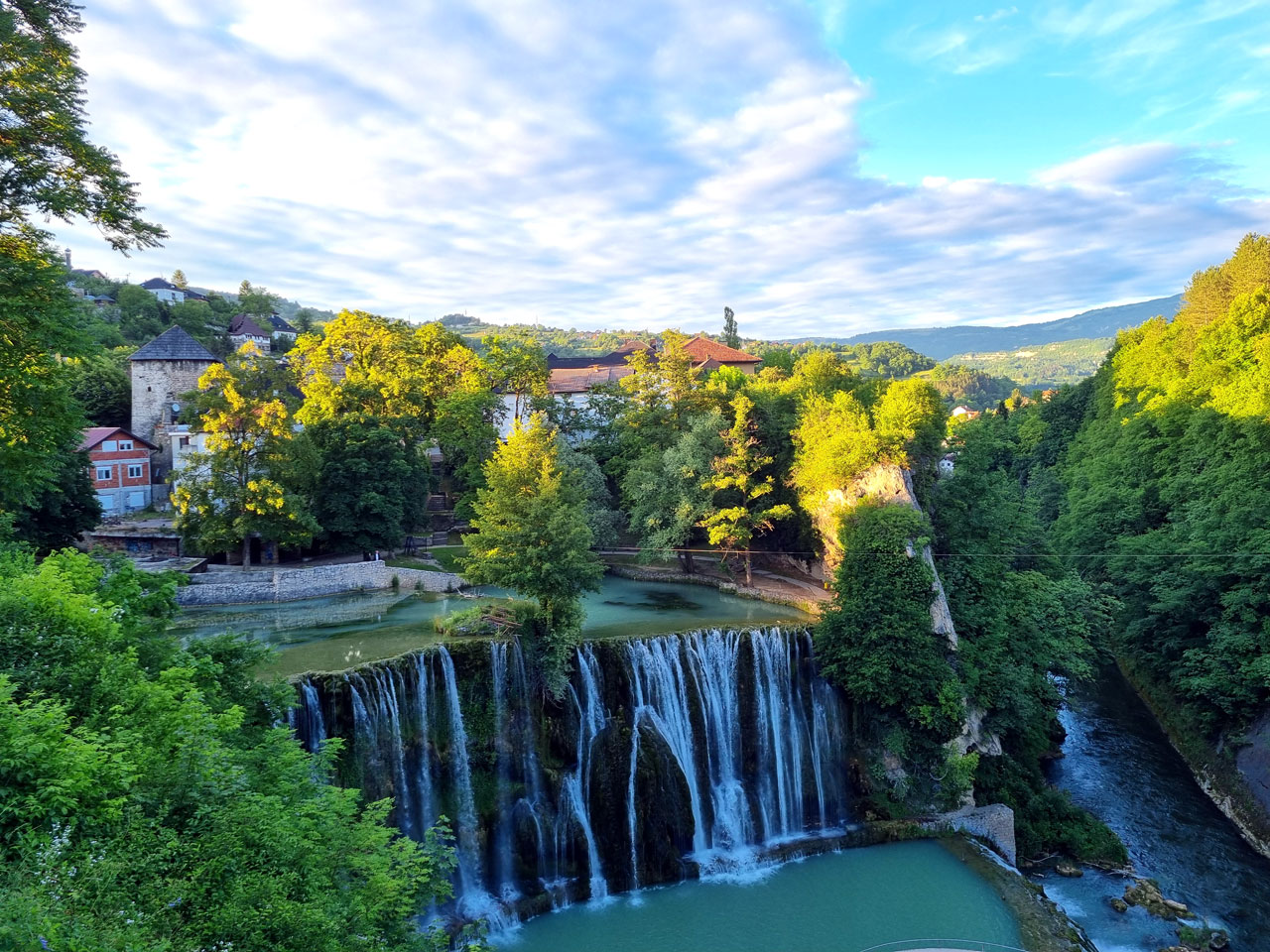
The charming small town of Jajce is an absolute gem right in the heart of Bosnia that represents everything that’s so unique about the country.
The town centre is dominated by a hilltop fortress and you can walk along its walls surrounding the compact old town. And like with most towns in Bosnia, you’ll find mosques pretty much next door to Christian churches, representative of the country’s unique cultural mix. As you explore this quaint little town you’ll still notice the scars of the brutal Bosnian War of the 1990s – abandoned and bullet-hole-ridden houses – a recurring theme across many parts of Bosnia.
But what really stands out about Jajce is a mere couple minutes walk from the Old Town. There, you’ll find the most stunning Pliva Waterfall. While Bosnia is blessed with beautiful waterfalls, it’s particularly rare to find such a spectacular one right in town. It’s the point where the emerald waters of the Plivsko Lake meet the Vrbas river and travel onward, carving out the beautiful gorges that surround the town.
For a relaxing lakefront getaway, you’re only a short drive from the stunning Plivsko Lake. You can rent an electric boat or e-bikes, or just relax and take in the views. There is a quirky cafe near the parking called Lake View with every kind of seat you can possibly imagine. Or you can opt for one of the small beaches for a refreshing swim.

Getting to Jajce:
Driving is the best option, a 2.5 drive from Bosnia’s capital Sarajevo and a similar time to Mostar. You can also get a bus from Sarajevo which takes a little over 3 hours, or a 5-hour bus from Mostar.
Jajce makes for a perfect destination as you head north out of Sarajevo or make your way towards North/NW Bosnia or onwards to Croatia’s Plitvice Jezera.
Alternatively you could also consider or stop in nearby Travnik with its dramatic fortress.
Una National Park

If you’re after a truly quaint and scenic stay with plenty of outdoor activity potential, I recommend adding Una National Park to your itinerary.
Located on the Northwestern border with Croatia naturally shaped by the calm and emerald Una River, the Una National Park is a fantastic region for outdoor activities, or just chilling in the rural Bosnian scenery for a while.
Majestic waterfalls are a recurring theme right across Bosnia, and Una National Park is no exception. One of the park’s highlights are the Great Una Waterfalls. Surrounded by lush greenery, it’s such a peaceful spot to relax and enjoy nature. There were few people when we visited, despite the falls being very accessible with just a short walk from the nearest parking.
There aren’t really any towns in Una National Park – as it’s, well – a national park. Just the occasional farming village. But you can still find a rural guesthouse on booking.com or airbnb at a delightfully affordable price. Or alternatively, you could instead stay in the nearest city of Bihac to the north – a pleasant place in its own right.
Getting to Una National Park
Granted, it’s a little separate from the rest of the itinerary. It’s a 2-hour drive NW from Jajce, and over double that from Sarajevo and Mostar at the other end of the country. So to me this is particularly suited for an road trip itinerary that goes onwards into Croatia (the far more famous Plitvice Lakes National Park is just over an hour’s drive away). From the nearest town of Bihac, it’s roughly 40 minutes by car. Probably the only reasonable transport mode to explore the area with.
Does Bosnia & Herzegovina have beaches?
Yes – one! While Croatia almost entirely wraps the Adriatic coastline to Bosnia’s West, there is just the one seaside town Neum that enjoys beach access. It’s quite a pleasant ethnic Croatian place that has a few beaches and a nice promenade, but don’t expect too much. It basically feels like a typical coastal town in Croatia and f you want a Balkan beach holiday – just go to Croatia, Montenegro or Albania instead. Which is why I left Neum out of this Bosnia travel itinerary.

How to get to Bosnia?
The most obvious route is flying into Sarajevo International Airport, serving most of the major hubs from Europe as well as the Middle East. However another good option that we opted for is to fly into Croatia’s Dubrovnik (or Split, or Zadar), rent a car, and make the loop across the border. There is a wider range of low-cost flights heading to Croatia’s coast so you can actually save some money while mixing in a bit of Adriatic seaside into the trip.
If you’re crossing the border from Croatia, the queuing times are a bit of a lottery. The Neum crossing took us minutes, but I know of others who waited over an hour at some of the other border controls. Make sure to tell your rental provider you plan on driving in Bosnia, as it’s not in the EU so requires adequate insurance.
I hope this Bosnia guide helps you plan an epic road trip holiday – if you have any questions – reach out with a comment below. If you’re considering other road trip holiday options in Europe, check out my guide to 9 Wonderfully Affordable Road Trip Destinations in Europe.
Found this guide useful? You can support the site with a coffee ☕ — it helps cover hosting costs.


4 Comments
Jorge Falcon
Hi there – this is a very interesting and well written post. Thank you very much!
My plan is to spend 2 full days in Sarajevo. From there I am planning to drive to Travnik – spend ~3-4 hours and continue to Jajce to spend the afternoon, night and the next morning. At noon I plan to drive south to Jablanica for a quick lunch and further south to Mostar, where I plan to spend ~2-3 nights (2 full afternoons + 1 half day morning in Mostar + daytrips). After Mostar I plan to drive to Trebinje, return the car and cross via bus to Kotor in Montenegro (and then to Albania)
What do you think? Is driving north for the quick visits to Trevnik and Jajce worth it? From your perspective, are the timings right for each place?
Thanks a lot!
Nikita
Thanks Jorge!
Depends on how you like to travel. For me this is totally doable and similar to the time I spent in each area. Mpst of these places are quite small, Sarajevo and perhaps Mostar being the exception. I’d say the trip up North is worth it, especially for Jajce.
Enjoy your trip!
Tasneem Alsharqi
Thank you for the detailed guide, may I ask about the fuel cost to do the whole trip and car rental cost please? Thank you
Nikita
Hi Tasneem,
We rented the car in Dubrovnik and left it in Zagreb, i.e. one way rental. Came to around £25/day in May/early June. Can’t remember about fuel costs – but fuel is relatively cheap in Bosnia & Herzegovina.